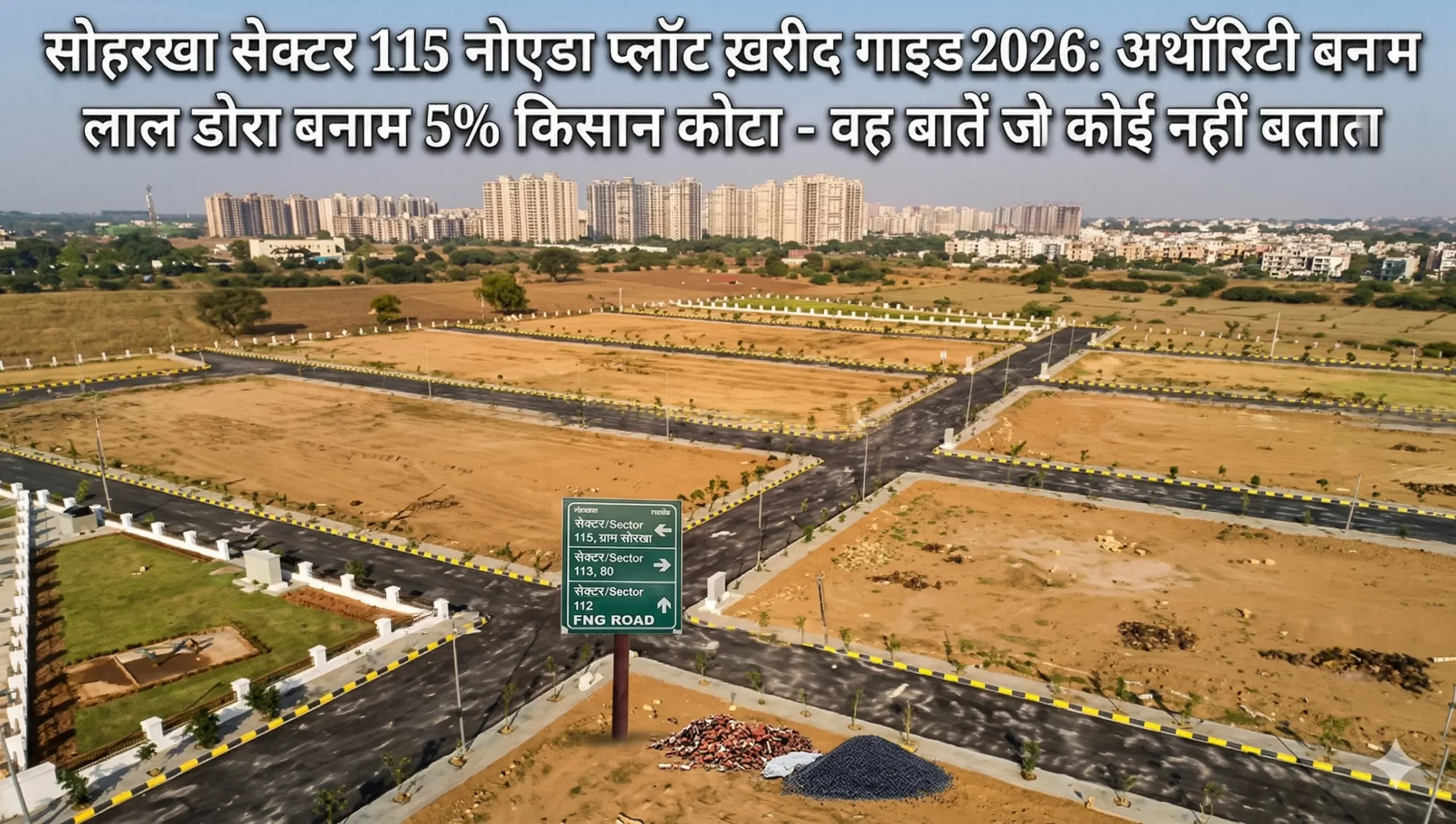
Sorkha, Sector 115, Noida is one of those places where real money is being made — and real mistakes are being made — at the same time. Land prices have jumped, infrastructure is catching up fast, and everyone from first-time buyers to seasoned investors is asking the same question: is now the right time to buy a plot here? The honest answer is — it depends entirely on which type of plot you are buying and whether your documents are in order. Most buyers only find out the hard way that not all plots in Sorkha are equal. A Lal Dora plot and a Noida Authority plot can sit 100 metres apart, look identical on the ground, and have completely different legal standings, loan eligibility, and risk profiles. This guide breaks all of that down — in plain language, without the sales pitch.
⚡ Quick Answer — Sorkha Plot Legal Status 2026
Is Buying a Plot in Sorkha, Sector 115 Safe?
- Authority Plots: Only e-auctioned Group Housing or Institutional plots in Sector 115 with an Allotment Letter are 100% safe and bank-loan eligible.
- 5% Farmer Quota Plots: Moderately safe — but only after the Transfer Memorandum (TM) is completed. Bank loans are possible post-TM.
- Lal Dora / Abadi Plots: “Freehold” does not mean risk-free. No bank loans. No Completion Certificate. High demolition risk if on green belt or floodplain.
- 2026 GPA Update: Noida Authority now allows registry on multiple-GPA transfers but charges a penalty — 10% extra for 2nd GPA, 15% for 3rd and beyond. This is not a free pass.
- Bottom Line: Sorkha has both genuine opportunity and serious traps. The difference often comes down to a single document you have or don’t have at the time of the token.
1. Why Sorkha? The Real Opportunity (and the Real Risk) in 2026
Sorkha is trending on every Noida property group for a reason — but the story has two sides that most agents conveniently skip.
Sorkha village sits inside what is broadly mapped as Sector 115, Noida. It’s close to the FNG (Faridabad-Noida-Ghaziabad) Expressway, within easy reach of Sectors 76 and 78, and hemmed in by premium projects like Ivory County. As Noida’s infrastructure push in this belt has accelerated — new arterial roads, expressway ramps, institutional zones — land prices in and around Sorkha have climbed sharply.
The draw is simple: you’re getting what looks like a “premium zone” address at prices well below Authority-allotted plots in nearby sectors. For end-users wanting to build their own home and for investors looking at 3–5 year appreciation, that gap is hard to ignore.
But here is what the agents selling you a “Sorkha plot at great deal” often won’t tell you: Sorkha is a patchwork of land types. A plot 50 metres from a legitimate Authority-allotted site can be Lal Dora village land with zero bank-loan eligibility and real demolition risk. The proximity to Ivory County does not make a Lal Dora plot “as good as” an Authority plot. Understanding the difference is, literally, the difference between a sound investment and a very expensive mistake.
📍 Location Context
Sorkha village is located within Sector 115, Noida, near the FNG Expressway. Ivory County (a RERA-approved township) is the most visible landmark. The “Shiv Gate” area and localities near Mahadev Apartments mark the common zones where Authority plots and Lal Dora plots are most easily confused.
2. The 3 Legal Layers: Authority Plot vs 5% Farmer Quota vs Lal Dora
Most buyers only hear “plot in Sector 115.” The first question you must ask is which of these three categories that plot falls into — because they are not interchangeable.
Layer A: Noida Authority Planned Plot (The Safest Zone)
A true Noida Authority plot comes from the Authority itself — it is carved out of land that was acquired from farmers, planned into sectors, and either e-auctioned or allotted through official schemes. In Sector 115, this typically means Group Housing and Institutional plots, not standalone residential plots (which is why standalone residential plots here are rare and expensive).
These plots come with an Allotment Letter from the Noida Authority. This is the foundational document. Everything else — registry, bank loan, construction permission — flows from it. If someone says “Noida Authority plot” but cannot show you an Allotment Letter, the claim is unverified.
✅ What Makes It Safe
Allotment Letter from Noida Authority · Bank loan eligible (SBI, HDFC, all nationalized banks) · Clear title, no demolition risk · Registry straightforward at Sub-Registrar with Authority’s endorsement
Layer B: 5% Farmer Quota Plot (Moderate Risk — Manageable with Documents)
When the Noida Authority acquires agricultural land from farmers, it gives back 5–7% of that acquired land as residential plots to the farmers as compensation. These “5% plots” are a legitimate, Authority-recognised category. However, they come with a crucial condition: the plot must go through a Transfer Memorandum (TM) before it can be freely bought and sold.
Many of the “residential plots” you see for sale in Sorkha are originally 5% Farmer Quota plots that have changed hands — sometimes multiple times — without the TM being completed. Each such transfer adds complexity and cost.
⚠️ The TM Trap
If you are buying a 5% Farmer Quota plot, verify that the Transfer Memorandum is completed and in the seller’s name. Without TM, you cannot do a proper registry. The cost of completing a delayed TM is not small — and it’s your problem as the buyer.
Layer C: Lal Dora / Abadi Land (High Alert Zone)
Lal Dora (literally “red thread”) refers to the old village settlement area — the land that was demarcated as the original village boundary before urbanisation. Abadi land is effectively the same — village habitation land. Most of the residential plots sold by locals in Sorkha fall in this category.
Sellers and agents will often describe this as “freehold land” — which is technically true in a historical, village-customary sense. But freehold does not mean no-risk in the Noida urban context. Here is why:
- The Noida Authority treats anything built outside the original Lal Dora boundary (the “red line”) as an unauthorised extension — which it can and does demolish.
- You cannot get a Completion Certificate from the Authority on such land, which means no legal UPPC electricity connection and no home loan.
- In 2025–26, the Noida Authority has reclaimed over 150 acres of encroached land in Sorkha — including illegal constructions on floodplains and green belt zones. Buyers of such plots have had no recourse.
🚨 Critical: No Bank Loan on Lal Dora
Nationalized banks — SBI, HDFC, PNB, Bank of Baroda — do NOT provide home loans on Lal Dora or GPA-only plots. If a dealer tells you “loan is possible,” they are referring to an unsecured personal loan at 12–18% interest, not a home loan. This is a significant red flag about the dealer’s credibility.
3. Sorkha Plot Types: Side-by-Side Comparison
| Feature | Authority Plot (Sector 115) |
5% Farmer Quota Plot | Lal Dora / Abadi Plot |
|---|---|---|---|
| Who allotted it? | Noida Authority (e-auction / scheme) | Noida Authority to original farmer (5% of acquired land) | Village origin — not Authority-allotted |
| Key document | Allotment Letter + Registry | Allotment Letter + Transfer Memorandum (TM) | Sale Deed / GPA — no Allotment Letter |
| Bank loan eligibility | ✅ Yes — all major banks | ⚠️ Possible after TM | ❌ No — only personal loan |
| Registry at Sub-Registrar | ✅ Normal process | ⚠️ After TM + Authority stamp | ⚠️ GPA penalty 10–15% |
| Completion Certificate | ✅ Available | ⚠️ After compliance | ❌ Not available |
| Legal electricity (UPPC) | ✅ Normal | ⚠️ After CC | ❌ Difficult / illegal |
| Demolition / reclaim risk | Minimal — planned sector | Medium if TM is pending | High — especially on floodplain, green belt, or outside Lal Dora red line |
| Price premium over circle rate | 10–20% above (limited supply) | 15–30% above circle rate | 40–70% above circle rate (demand despite risk) |
| Resale ease | Easy — clear title | Moderate — TM status matters | Difficult — GPA chain issues, no loan for buyer |
| Noida Authority stamp required? | Yes — standard for any sector plot | Yes — TM + registry both need Authority’s nod | Yes — and this is where most deals stall |
💡 Key Insight
A “Pakki Registry” (registered sale deed) at the Sub-Registrar’s office is NOT enough for true, clean ownership in Sorkha. For any plot that traces back to Noida Authority land — including 5% farmer quota — you also need the Noida Authority’s own endorsement/stamp on the transfer. Without it, the registry is legally incomplete in the Authority’s eyes.
4. GPA vs Registry in Sorkha: The 2026 Rulebook
The GPA (General Power of Attorney) issue is the single most misunderstood part of buying property in Sorkha. Understanding it could save you lakhs — or spare you years of legal trouble.
What is a GPA and Why is it Common in Sorkha?
A General Power of Attorney is a legal document authorising someone to act on your behalf — including selling property. In Sorkha and similar village-origin plots, GPA-based transfers became common because direct registry was either not possible (as in Lal Dora land) or was being avoided to save on stamp duty.
The result: many plots in Sorkha have changed hands 2, 3, or even 4 times through a chain of GPAs — without a single proper registry. The current “owner” has a GPA from someone who had a GPA from someone else, and so on. You are not buying property. You are buying a chain of attorney powers. This is legally fragile.
Can You Do Registry Now? The 2026 Noida Authority Policy
Yes — with a cost. In 2026, the Noida Authority updated its policy to allow registry of properties that have passed through multiple GPA transfers. This is not amnesty; it is a regularisation with a penalty.
📊 GPA-to-Registry Fee Calculator (Sorkha, 2026)
Example: Plot value ₹40 Lakh — Sorkha Sector 115 Lal Dora / Village Plot
Circle Rate Stamp Duty (standard)
Calculated on circle rate or agreement value — whichever is higher
~7%
1st GPA → Registry
Standard transfer — treated as first-time registry
No penalty
2nd GPA → Registry
Plot changed hands once via GPA before reaching you
+10% of plot value
3rd GPA (or more) → Registry
Plot changed hands 2+ times via GPA chain
+15% of plot value
On a ₹40L plot with a 3rd-GPA chain:
Penalty 15% = ₹6L + Stamp duty 7% = ₹2.8L = ~₹8.8 Lakh additional cost
~₹8.8L extra
⚠️ Important: Sub-Registrar Registry ≠ True Ownership
Even after paying the GPA penalty and getting a registry done at the Sub-Registrar’s office, you still need the Noida Authority’s own stamp of approval on the transfer to be considered the true owner in the Authority’s records. The registry is step one — Authority endorsement is step two. Many buyers complete step one and assume the job is done.
What Documents Do You Need for GPA-to-Registry in Sorkha?
- Complete GPA chain — original GPA documents for every transfer in the chain
- Original sale deed / agreement to sell from the first transaction
- Khasra Nakal (land record extract) — verify on Bhulekh UP portal
- Mutation / Dakhil Kharij in the current seller’s name
- NOC from Noida Authority (where applicable)
- Proof of penalty payment (demand draft / challan as per Authority’s instruction)
- ID/address proof of both buyer and seller
5. Circle Rate vs Actual Market Rate in Sorkha Sector 115 (2026)
One of the most common questions — and one of the most misunderstood dynamics in Sorkha’s property market.
The circle rate is the government-mandated minimum value at which a property can be registered. Stamp duty is calculated on this rate. In Sorkha/Sector 115, the circle rate is approximately ₹44,000 per square metre for residential land as of 2026.
The actual transaction price, however, depends heavily on the plot type — and ironically, riskier plots often command a higher premium over circle rate precisely because they are available and “negotiable” in ways that Authority plots are not.
Circle Rate (Base)
₹44,000
/sq.m
Government-mandated. Stamp duty calculated on this figure. Applies across all plot types.
5% Farmer Quota Plots
15–30%
above circle rate
Premium driven by legitimacy + limited supply. More predictable and loan-eligible post-TM.
Lal Dora / Abadi Plots
40–70%
above circle rate
Paradoxically higher premium due to scarcity + “negotiable” documents. No bank loan means all-cash deals, which inflates values.
This price paradox is worth understanding: Lal Dora plots sell at a higher premium over circle rate than 5% plots, even though they carry more risk. Why? Because all transactions are cash-based (no bank financing), the market is opaque, and sellers have full pricing power. The “premium” you pay is partly for the risk, not despite it.
💡 FNG-Side vs Shiv Gate Side: Does Location Within Sorkha Matter?
Yes. Plots near the FNG Expressway side tend to command a higher price due to connectivity — but they also carry a higher risk of waterlogging and sewer-related issues (see Section 6). Plots near Shiv Gate and the Mahadev Apartments area are typically where Lal Dora and Authority boundaries blur most confusingly. Always physically verify the plot’s position relative to the Lal Dora boundary before any negotiation.
6. 5 Red Flags in Sorkha That No One Tells You
These are the issues that real estate portals skip because they have no interest in killing your deal. You need to know all of them.
🚰
The Sewer / Drain-Water Plot Problem
Several plots in Sorkha — particularly near the Sector 112–115 border and FNG-adjacent zones — are periodically filled with drain water from the stagnant sewage network. Multiple cases have been reported where plots are effectively submerged or unusable during monsoons. This is not a minor inconvenience — it can render a plot unbuildable for months and significantly affects resale. Always visit during or just after monsoon season, or ask local residents directly.
Source: Times of India, Noida edition
🏗️
Demolition Risk: 150 Acres Reclaimed in Sorkha
This is not a theoretical risk. In 2025–26, Noida Authority demolished illegal constructions in Sorkha, reclaiming over 150 acres — primarily from floodplain areas and green belt encroachments. The Authority reclaims without compensation. Before buying, check the Noida Master Plan 2031 for the specific Khasra number of your plot.
Source: Millennium Post, Sorkha 2025–26
⚡
No Legal Electricity on Unauthorised Plots
UPPC will not provide a legal electricity connection to a structure without a Completion Certificate. Many Sorkha residents in Lal Dora extensions run on informal or borrowed connections. When you apply for a metered connection after building, you may be denied — or face a demand for documents you don’t have. Factor this into any plan to build and live there.
🏦
The “Loan is Possible” Dealer Myth
If a dealer says “bank loan is possible” on a Lal Dora or GPA-only plot, ask them to name the bank and branch. They cannot — no nationalised bank extends home loans on such properties. What they mean is a personal loan or NBFC loan at 12–18% interest — not a home loan. Your EMI burden will be far higher than you expect.
🌿
Green Belt Encroachment — High Demolition Trigger
Noida’s Master Plan designates certain areas as “Green Belt” — no residential or commercial construction is permitted there under any circumstance. Some plots in Sorkha sit on Green Belt or floodplain land. These are the first targeted in demolition drives. No regularisation, no amnesty, and no compensation has been offered in past drives. Check the green belt boundary on the Master Plan before any token payment.
📄
“On Paper” vs “On Ground” — Verify Physically
A surprisingly large number of plots sold in Sorkha are “on paper” only — the physical plot is either occupied by someone else, encroached upon, or unclear on the ground. Before paying even a token amount (Bayaana), do a physical verification with the seller present. Measure the plot against boundary markers. Check that neighbours’ structures don’t encroach on your would-be plot.
7. Dakhil Kharij (Mutation) in Sorkha: What It Is and How to Do It
Mutation is the process of updating government land records to reflect a new owner’s name after a property transaction. It is not the same as registry — but it’s equally important.
Many buyers in Sorkha complete the registry and stop there. They don’t realise that mutation (Dakhil Kharij) is what updates the actual land revenue records — the Khatauni — at the Tehsil level. Without mutation, the revenue records still show the old owner’s name. This creates problems in resale, in legal disputes, and in proving possession.
Go to upbhulekh.gov.in → Enter district (Gautam Buddha Nagar), Tehsil, Village (Sorkha) → Verify Khasra number and current owner in Khatauni records. Confirm the seller’s name matches. If it doesn’t, find out why before proceeding.
Ensure the sale deed is registered at the Sub-Registrar’s office. For Authority-linked plots, also obtain Noida Authority’s stamp/endorsement on the transfer at this stage.
Submit the registered sale deed + application to the Tehsildar (Dadri Tehsil for Noida). Required documents: sale deed copy, Khatauni copy, ID proof of buyer, court fee stamp. There is no fixed government fee — only a small court fee stamp.
The Tehsildar issues a notice to the old owner / adjoining landowners. If there are no objections within the notice period (typically 30 days), mutation proceeds.
Once approved, the Tehsildar issues the Mutation Order (Dakhil Kharij) and your name is updated in the Khatauni (land revenue record). Download and keep this. Verify online on Bhulekh UP.
⚠️ If the GPA Chain is Long…
In Sorkha, where plots have often passed through multiple GPAs, mutation may not have been done at each stage. This means the Khatauni still shows the original farmer’s name — not your seller’s. The mutation process then becomes more complex. This is best handled with a local advocate (not a “property agent”) before you pay any money.
8. Pre-Token Checklist: Do This Before You Pay a Single Rupee
The “Token” (Bayaana) seems small — ₹10,000 to ₹1 lakh typically — but once paid, backing out becomes legally and practically difficult. This checklist is what you do before that moment.
-
1Verify the Khasra Number on Bhulekh UP
Ask for the exact Khasra number and village name. Go to upbhulekh.gov.in and verify that the Khatauni shows the seller as the current owner. If the seller’s name is not in the land records, that is a serious red flag. Do not proceed until this is resolved. -
2Ask for the Original Allotment Letter or GPA Chain
If it’s an Authority or 5% plot — demand the original Allotment Letter from Noida Authority. If it’s a Lal Dora/GPA plot, ask for the complete GPA chain from day one. Count how many GPAs are in the chain — this directly determines your regularisation penalty (10–15%). -
3Check the Noida Master Plan for Green Belt / Flood Zone
Download the Noida Master Plan 2031 (available on noidaauthority.in) and check whether the Khasra number of your plot falls in a Green Belt, Flood Zone, or Agricultural Reserve area. These are demolition-risk zones. No agent will tell you this. -
4Physical Verification — Visit the Plot Yourself
Go to the actual plot. Check that it is physically demarcated and that there are no encroachments. Talk to 2–3 neighbours and ask them about waterlogging during monsoon, electricity situations, and any disputes on the land. -
5Verify Mutation (Dakhil Kharij) is in Seller’s Name
A registry in the seller’s name is not the same as mutation being done. Check on Bhulekh UP that the Khatauni (land revenue record) shows the seller’s name. This confirms legal possession, not just paper ownership. -
6Ask: Is NOC from Noida Authority Required? Is It Available?
For any plot in Sorkha that traces to Authority land — even a 5% farmer quota plot — check whether an NOC (No Objection Certificate) from Noida Authority is required for the transfer. If yes, has it been obtained? If not, factor in the time and cost. -
7Confirm Bank Loan Eligibility (If You Need One)
If your purchase plan involves a bank loan, go to an SBI or HDFC branch first with the plot details and confirm they will lend on it. Do this before paying the token — not after. If you are buying a Lal Dora plot expecting to arrange a loan, this step will save you from an unpleasant surprise. -
8Get a Local Advocate’s Opinion — Not Just an Agent’s
A real estate agent is not qualified to give legal advice on title clarity. Before paying any significant amount, spend ₹3,000–5,000 getting a title opinion from a registered advocate practising in the Gautam Buddha Nagar district court. This is the single best investment you can make in this process.
9. FAQ — Everything People Ask About Sorkha Sector 115 Plots
10. Final Verdict: Should You Buy a Plot in Sorkha in 2026?
Sorkha is not a no-go zone — but it is a zone where the difference between a well-researched buy and a rash one is measured in lakhs of rupees and years of legal trouble.
The genuine opportunity exists for buyers who do their homework: verify the plot type, insist on complete documentation, check the Master Plan, and don’t let an agent’s urgency pressure them into a token payment before due diligence is complete. The infrastructure push in this part of Noida is real, and if you can get a clear-title 5% Farmer Quota plot with TM completed, or an Authority plot at the right price, the medium-term appreciation case is solid.
The trap exists for buyers who see the FNG Expressway, hear “Sector 115,” and assume all land here is equivalent. It is not. A Lal Dora plot at 70% above circle rate with a 3rd-GPA chain, on potential floodplain land, with no bank loan eligibility and active demolition risk in the neighbourhood, is not an opportunity — it is a liability dressed in real estate language.
✅ The Rule of Thumb for Sorkha
Buy the document, not the location. The address is Sector 115 for any plot in the area. But only one document makes a plot genuinely secure: an Allotment Letter from Noida Authority. Everything else — GPA chains, Lal Dora “freehold,” proximity to Ivory County — is a version of “it should be fine.” In property, “should be fine” is not a standard of due diligence.
Key Resources to Bookmark for Your Sorkha Due Diligence
- Bhulekh UP (upbhulekh.gov.in) — Khasra and Khatauni verification
- Noida Authority (noidaauthority.in) — Master Plan download, plot allotment records
- RERA UP (up-rera.in) — Check if any project on or near your plot is RERA registered
- IGR UP (igrsup.gov.in) — Registry and stamp duty payment portal
- Dadri Sub-Registrar Office — Actual registry for Sorkha-area plots
🚇 Also Useful Before You Decide
Connectivity is a key factor in long-term appreciation for any plot in this belt. Before finalising your decision, check our detailed guide on the nearest metro station to Sector 115 Noida — it covers walking distance, planned extensions, and how transit access compares across different pockets of Sector 115.
Have a Specific Sorkha Plot Question?
Drop the Khasra number, the plot type as told to you by the seller, and any documents you have — and ask in the comments. Many buyers in Sorkha are navigating the same decisions. The more specific your question, the more useful the answer for everyone.